Where mobility meets governance
Smart Urban Transport is where mobility meets municipal governance, energy networks, public safety and citizen experience. It covers traffic signal optimisation, Intelligent Transport Systems on highways and arterials, public transit modernisation, multi-modal hubs, parking, congestion pricing, low-emission and clean-air zones, freight access management, vulnerable-road-user safety and emergency response coordination. alticdigital’s Smart Urban Transport practice builds the data, AI, integration and assurance layer that lets transport authorities operate cities as systems — under the engineering and audit discipline that public-sector procurement, transparency obligations and citizen scrutiny require.
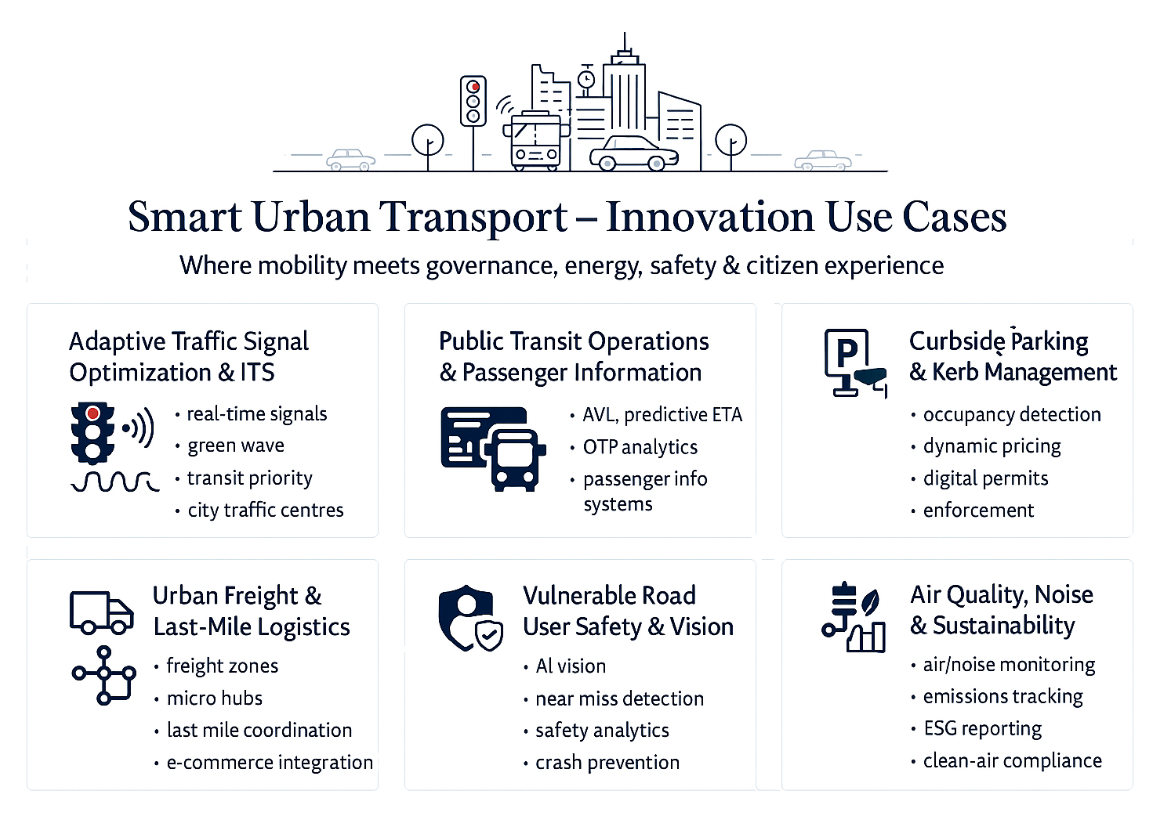
Smart urban transport use cases
Adaptive Traffic Signal Optimisation and ITS
Real-time signal control adapting to live traffic, public-transport priority and pedestrian demand; integration with loop detectors, radar, lidar, computer-vision cameras and connected-vehicle data; corridor-level coordination; AI-driven green-wave optimisation; transit-signal-priority for buses and emergency vehicles; integration into city-wide Traffic Management Centres.

Real-time signal control adapting to live traffic, public-transport priority and pedestrian demand; integration with loop detectors, radar, lidar, computer-vision cameras and connected-vehicle data; corridor-level coordination; AI-driven green-wave optimisation; transit-signal-priority for buses and emergency vehicles; integration into city-wide Traffic Management Centres.
Public Transit Operations and Passenger Information
Automated Vehicle Location, on-time-performance analytics, predictive ETA, headway-based management and crowding analytics for buses, metros and trains; passenger information systems across apps, station displays, on-vehicle screens and voice channels; AI-driven service-planning, run-cutting and crew-rostering; fare evasion analytics; multi-modal interchange optimisation.

Automated Vehicle Location, on-time-performance analytics, predictive ETA, headway-based management and crowding analytics for buses, metros and trains; passenger information systems across apps, station displays, on-vehicle screens and voice channels; AI-driven service-planning, run-cutting and crew-rostering; fare evasion analytics; multi-modal interchange optimisation.
Curbside, Parking and Kerb Management
Sensor- and computer-vision-based occupancy detection; dynamic pricing of on-street parking; digital permits for residents, freight and ride-hailing pick-up / drop-off zones; loading-bay reservations; enforcement-camera integration; emissions-based pricing for low-emission zones; integration with payment, navigation and freight-management apps.

Sensor- and computer-vision-based occupancy detection; dynamic pricing of on-street parking; digital permits for residents, freight and ride-hailing pick-up / drop-off zones; loading-bay reservations; enforcement-camera integration; emissions-based pricing for low-emission zones; integration with payment, navigation and freight-management apps.
Urban Freight, Logistics and Last-Mile Coordination
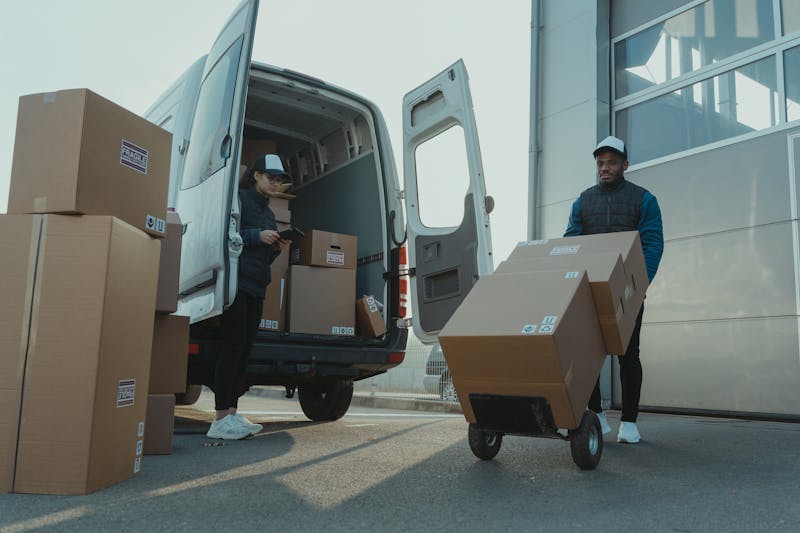
Freight access management for restricted zones; off-peak and night delivery enablement; micro-consolidation hubs; cargo-bike and electric-van logistics platforms; last-mile coordination across e-commerce, food-delivery and on-demand operators; data-sharing platforms aligned to emerging Urban Logistics standards.
Freight access management for restricted zones; off-peak and night delivery enablement; micro-consolidation hubs; cargo-bike and electric-van logistics platforms; last-mile coordination across e-commerce, food-delivery and on-demand operators; data-sharing platforms aligned to emerging Urban Logistics standards.
Vulnerable Road User Safety and Vision Zero Analytics
AI computer-vision analytics on cameras to detect near-miss events, illegal turns and unsafe interactions; pedestrian and cyclist heat-mapping; crash-prone-corridor identification; speed-zone analytics; e-scooter and cycling-infrastructure analytics; integration with Vision Zero, Safe System and ISO 39001 road-safety frameworks.

AI computer-vision analytics on cameras to detect near-miss events, illegal turns and unsafe interactions; pedestrian and cyclist heat-mapping; crash-prone-corridor identification; speed-zone analytics; e-scooter and cycling-infrastructure analytics; integration with Vision Zero, Safe System and ISO 39001 road-safety frameworks.
Air Quality, Noise and Sustainability Telemetry
City-wide air-quality and noise monitoring through fixed and mobile sensors; correlation with traffic flow and weather; emissions-zone effectiveness measurement; modal-shift impact assessment; ESG and CSRD reporting for transport authorities; alignment with WHO air-quality guidelines, EU clean-air directives and national clean-air missions.
City-wide air-quality and noise monitoring through fixed and mobile sensors; correlation with traffic flow and weather; emissions-zone effectiveness measurement; modal-shift impact assessment; ESG and CSRD reporting for transport authorities; alignment with WHO air-quality guidelines, EU clean-air directives and national clean-air missions.
Benefits, value and beneficiaries
Measurable reductions in journey times and corridor congestion; lift in public-transit on-time-performance and ridership; meaningful reductions in pedestrian and cyclist injury and fatality rates; measurable improvements in air quality and emissions in target zones; transparent, auditable operations data for public-sector accountability.
Cities meet decarbonisation, equity, safety and accessibility targets simultaneously; transport authorities reduce per-capita operations cost; private operators and freight users save time and fuel; citizens spend less time in traffic and more time at home; insurers and emergency services respond faster; central government grant funding becomes defensible against measurable KPIs.
Mayor and City Manager; Director of Transport at metropolitan and national authority; CIO of public-sector technology departments; Head of Traffic Operations Centre; Head of Public Transit; Head of Sustainability and Air Quality; Head of Urban Planning; Police and Emergency-Services leadership.
Customer Challenges and the Need to Act
Smart cities deliver only when their transport spine works
Every smart-city programme that has materially moved citizen outcomes has done so by getting the transport spine right first — adaptive signals, performant public transit, well-managed kerbside, safer streets and trustworthy data. Smart waste, smart lighting and smart governance are valuable, but they are not the spine. alticdigital partners with city and transport authorities to build that spine — under the public-procurement transparency, audit and citizen-accountability standards that public-sector clients alone are required to meet.
Relevant geographies
Let’s build smarter cities together
From adaptive traffic signals to Vision Zero analytics, our team builds the transport intelligence layer that cities need.
50+ Years of Industrial Assurance
alticdigital is the technology subsidiary of ISSPL — a classification and certification group with five decades of industrial-inspection heritage. Every solution we deliver inherits this culture of rigour, traceability and audit-grade quality.